
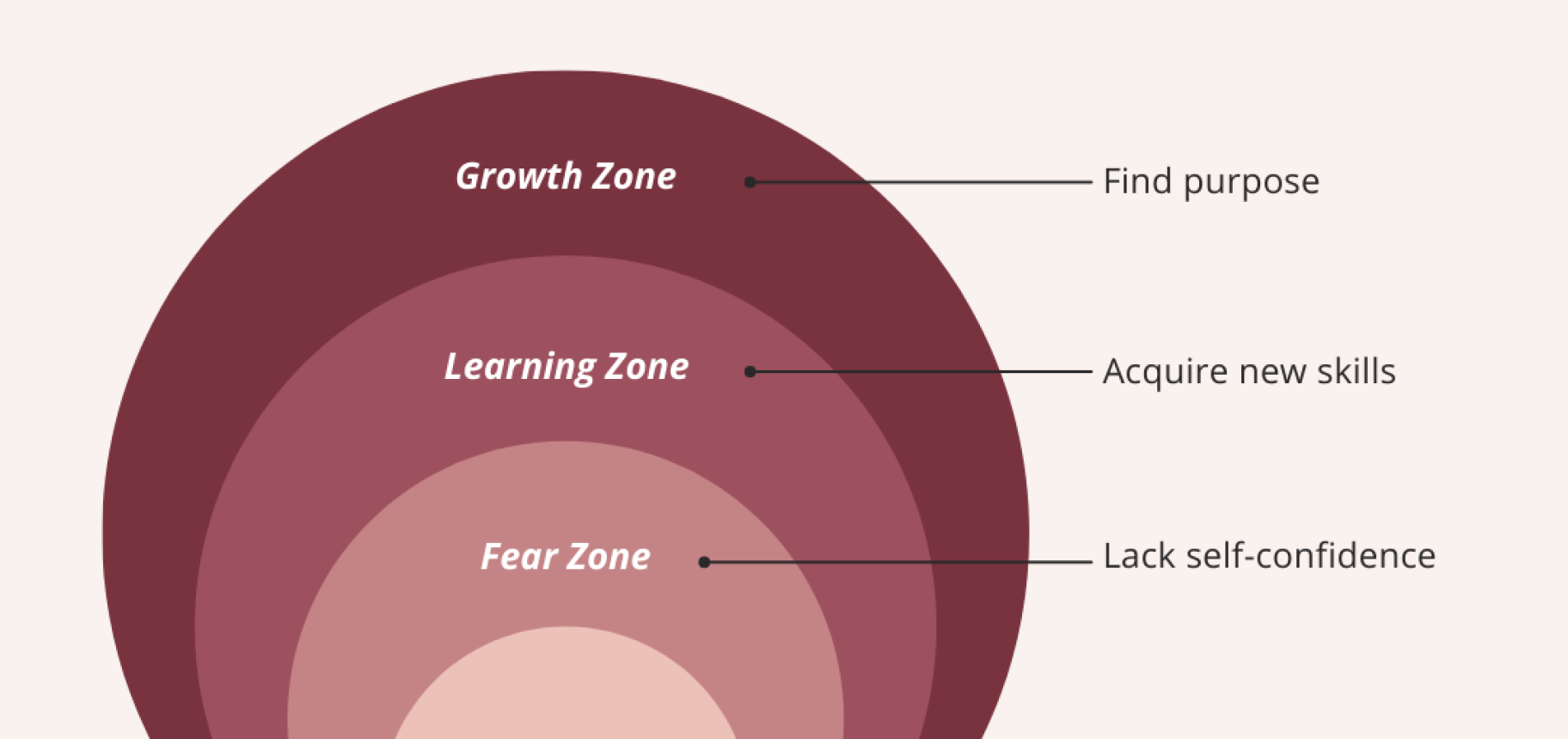
In a world fixated on self-discovery and personal growth, the concept of the “comfort zone” has almost become a cliché. Motivational images and posts urge us to push our limits, suggesting that true evolution begins where our comfort ends.
But if we pause for a moment and reflect, does this approach truly serve our development, or does it lead us into an internal struggle filled with self-criticism and demotivation?
What if I told you that this often-demonized zone could actually be a valuable guide on each of our journeys?
This perspective was taught to me by one of my guides on the path of (self)knowledge (this is how I like to call him), Dacian Păscuță, and it radically changed how I relate to my own evolution.
So, I want to share with you this way of viewing the comfort zone and hope it serves you as well as it has served me.
But what exactly is the comfort zone?
According to prevailing discourse, the comfort zone is that imaginary bubble where we feel safe but which prevents us from growing. We are encouraged to step out of this zone as though it were a duty, a mandatory rite of passage towards success and fulfillment.
But let’s look at things from another angle. What if our comfort zone actually indicates our most authentic values and priorities? What if it’s not a trap, but a guide?
The comfort zone theory starts from the idea that humans are naturally lazy, which is a misconception. Laziness and procrastination are merely signals that something doesn’t truly resonate with us. When something is genuinely important to you, when an activity or goal aligns with our values, action comes almost naturally.
This means you have focus, intention, and retention; things flow naturally, and there’s no need for someone to push you from behind.
It’s like sitting on the bank of a serene lake, feeling completely in harmony with yourself, while society encourages you to jump into unknown waters for growth. Because if you don’t, you’ll stagnate.
Think back to a time when you did something truly important for you. Have you identified one? Please don’t go further until you have such a moment in mind.
Was it necessary to force yourself out of comfort, or did it come naturally, as an extension of your being? In these cases, the comfort zone is nothing but a spotlight illuminating what truly matters to you.
Avoiding leaving the comfort zone likely reflects that those activities don’t align with your deep values and interests. In other words, they don’t resonate with what truly inspires you.
When we force ourselves to take this step and leave our comfort zone, the following happens:
you feel intense pain, which, far from being inspiring, seems to diminish you,
you find yourself wanting to quickly retreat back to your familiar comfort, and when you do, you feel overwhelmed by fatigue,
your attention is easily distracted, you get lost in thoughts, and you find it difficult to remember new information,
then, you criticize yourself for lacking motivation or for the tendency to procrastinate, labeling yourself as lazy.
Let’s not see the comfort zone as an enemy. It serves us 3 essential purposes, vital to us:
1. It’s a guide to authenticity: instead of forcing yourself out of the comfort zone, ask yourself why certain directions don’t resonate with you. It’s very likely that the answer will bring you back to your own paths, and you won’t follow others’ trails anymore.
2. It helps you develop as much as the discomfort zone does. Think about the muscle growth process. For a muscle to grow, you need to put enough stress on it to break the muscle fiber at the cellular level AND give it rest and space to recover and grow.
Simply put, muscles don’t grow while you’re in the gym (and exerting effort) but when they rest and recover. You can’t develop muscle mass without doing both actions.
I was recently studying a book about performance (I’m going to write an article on this subject, and if you’re skeptical, I’ll leave you some studies that confirm this) and Ernest Hemingway’s words stuck in my mind, saying that as difficult as his writing sessions were, waiting until the next day was the hardest part, when he forced himself to rest. Because he knew he “couldn’t perform” without rest.
And the top performers analyzed in the study reached the same conclusion: the maximum level of growth occurs in the middle of discomfort and comfort. It’s like a sweetspot.
We need moments of challenge, but also rest to process and integrate new experiences.
3. It reveals your fears.
The comfort zone can also show us what fears block our path. But if we work with these fears, we can unlock a huge potential for authentic growth and fulfillment.
Instead of artificially forcing ourselves out of comfort (we get there anyway when it’s natural for us), better to ask ourselves:
What values am I not honoring in my life?
Where have I exhausted myself and need recovery?
What fears are holding me back and how can I work with them to advance?
Changing our perspective on the comfort zone means honoring our authenticity and recognizing that true growth comes from aligning with our values, not from a constant struggle with ourselves.
Thus, we can evolve in a way that respects our essence and supports our wellbeing.
So, the comfort zone is not a place to be avoided at all costs, but a space that offers valuable clues about who we are and what we truly want.
Once freed from the myth that we must constantly fight against our own nature, we give ourselves the chance to find a more meaningful and satisfying path for us.
Personally, I believe this vision is a better way to sustainable and fulfilling growth and one that empowers us to be authentic.
So, let’s be gentle with ourselves and recognize that each of us has our own pace and path to follow.
And that the comfort zone is not an enemy, but a partner in our journeys towards becoming a more authentic and fulfilled version of ourselves.
You’ve likely heard many times that true magic happens outside your comfort zone.
So, today, I invite you to discover the “magic” within your comfort zone 🙂
PS: A short disclaimer. The article is not intended to justify those who do not want to leave their comfort zone at all, but rather to reduce motivational excess. Because the opposite is also true. As I was saying, the goal is to see both the benefits of the comfort zone and to use it as a growth partner. To find what inspires you, to identify your fears, and to work on yourself.
David
#globalentrepreneur #booklover
#strategicthinker